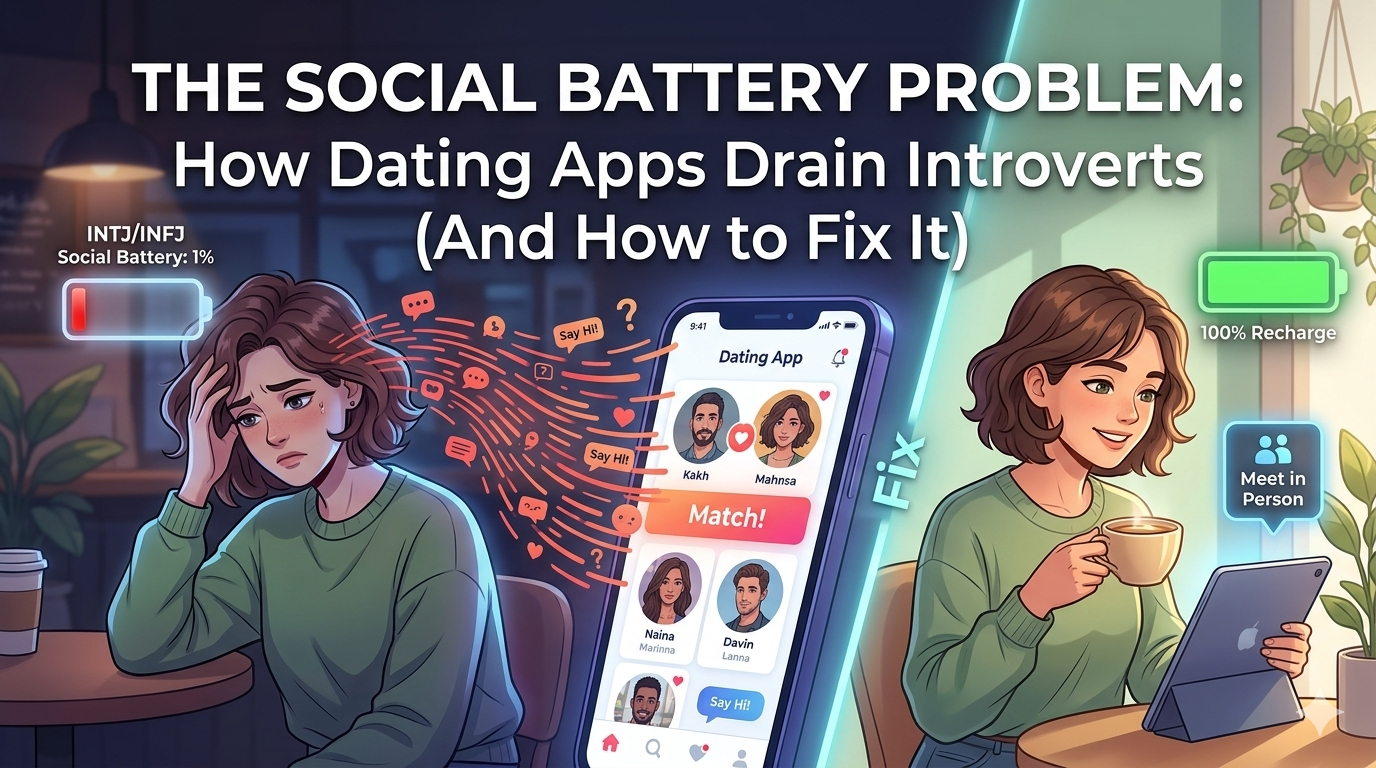
It's 8 PM on a Tuesday. You had every intention of being "good at dating" this week. But you've been staring at the app for six minutes without opening a single conversation. Your thumbs hover. Nothing comes out. You're not sad. You're not even particularly stressed. You're just... empty. Like someone pulled the plug on whatever internal resource makes human interaction feel possible.
So you close the app. Again. And feel vaguely guilty about it. Again.
If that sounds familiar, you're not being dramatic — and you're not failing at dating. Your social battery just ran out. And the way most dating apps are designed? They were never built to stop that from happening.
First, Let's Talk About What a Social Battery Actually Is
"Social battery" isn't just millennial slang for not wanting to go to brunch. It's a shorthand for a neurological reality — specifically, the finite reservoir of cognitive and emotional energy that human beings draw on during social interaction.
Everyone has one. But introvert social batteries are fundamentally different from extrovert ones — not in capacity, but in what recharges them. Extroverts draw energy from social stimulation. More interaction, more novelty, more engagement with other people — it fills their tank. Introverts work the other way: social interaction expends energy, and solitude restores it. Neither is better or worse. They're just different operating systems.
The problem? Dating apps were designed by and tested on the engagement patterns of the social-stimulation seeking user. They are, structurally, extrovert fuel. For introverts, they're the equivalent of leaving every light in your house on, all night, every night — and wondering why the power keeps going out.
The Numbers Don't Lie: Dating App Burnout Is a Real Crisis
Before we get into the how, let's sit with the how bad:
- 79% of dating app users report feeling emotionally fatigued by online dating, according to a 2024 Pew Research Study Centre.
- Nearly 60% describe the experience as "overwhelming" — not just occasionally, but as a baseline emotional state while using these platforms.
- A VICE investigation into dating app psychology found that the average active user makes over 140 micro-decisions per day on swipe-based apps — each one requiring a snap judgment about another human being.
- Hinge's own internal research found that users experience peak motivation drops after just 7 minutes of continuous swiping.
And those are the average users. For introverts — who process each interaction more deeply, who carry conversations in their heads long after they've ended, who experience social overstimulation more acutely — these numbers aren't averages. They're entry points.
Dating app burnout for introverts isn't a bug you've developed. It's a predictable, measurable outcome of a system that was never designed with your neurology in mind.
The 6 Ways Dating Apps Specifically Drain Introverts
Understanding exactly how your energy is being depleted is the first step to doing something about it. Here's the full breakdown:
1. The Infinite Queue of Human Beings
Open a major dating app on any given evening and you will be presented with an essentially endless stream of people to evaluate. This is, by design, overwhelming — it's meant to keep you in the app longer.
For extroverts, novelty is stimulating. A new face, a new profile, a new possibility — each one adds a small charge. For introverts, novelty isn't necessarily energizing. Each new profile isn't just a photograph — it's a social scenario to mentally simulate, a personality to tentatively model, a potential relationship arc to briefly imagine. Multiply that by 50 profiles in a session and you've just run a social marathon without leaving your couch.
2. The Cognitive Weight of Parallel Conversations
At any given moment, a "successful" dating app user is expected to maintain multiple active conversations simultaneously — each with their own context, tone, history, and emotional charge.
For extroverts, this can feel exciting, like keeping many fires lit at once. For introverts, managing five separate conversations with five separate strangers — remembering who mentioned the dog, who works in finance, who made the joke about the podcast — is a full-time cognitive load. It's not just tiring. It eventually makes all the conversations feel hollow, because you can't actually be fully present in any of them.
3. The Pressure to Perform on Demand
The unspoken contract of most dating apps is constant low-level performance: be charming, be funny, be interesting, be responsive — or watch your match interest evaporate. This creates a background hum of social anxiety that introverts carry differently than extroverts.
Extroverts tend to perform social warmth naturally and effortlessly in real-time. For introverts, social performance — especially sustained, context-light performance with strangers — requires deliberate effort. The cognitive load of "being on" across multiple conversations, every evening, for weeks or months? It's exhausting in a way that's genuinely hard to explain to someone who doesn't feel it.
4. The Notification Architecture Is Designed to Overstimulate
Dating apps are notification machines. You matched. They liked your photo. You have an unread message. They haven't replied in 24 hours — nudge them! This is operant conditioning — the same psychological mechanism behind slot machines — and it's extraordinarily effective at keeping extroverts perpetually engaged.
For introverts, who research consistently shows have higher baseline cortisol responses to unexpected stimulation, this notification architecture isn't engaging. It's draining. Every ping is a small interruption that pulls you out of whatever you were doing and forces a micro-decision: respond now, or feel guilty about not responding.
5. The Hollow Small Talk Treadmill
We've all been there. Match. "Hey." "Hey :) how's your week?" "Pretty good! Busy. You?" "Same haha." This isn't a conversation. It's a social preamble that serves as a placeholder until something real either happens or doesn't. For extroverts, this small talk is comfortable — it's familiar social friction that warms up a new relationship. For introverts, it's the most energy-expensive kind of interaction: it requires sustained social presence while delivering zero of the depth and meaning that makes social interaction worthwhile for them.
After two weeks of this loop across five conversations, the fatigue isn't about any individual person. It's about the structural emptiness of the format.
6. The Post-App Overstimulation Hangover
Here's the one nobody talks about: what happens after you close the app. Introverts don't just expend social energy during interaction — they often continue processing it afterward. The conversation you didn't know how to end. The person you're not sure you liked. The match that went quiet and now you're not sure what it means. This ambient social processing continues running in the background, drawing on cognitive resources even when the app is closed.
It's why a 30-minute session on a dating app can leave introverts feeling not just tired, but genuinely unable to focus on anything else for an hour afterward. The app is closed. The drain isn't.
Why You Keep Going Back (Even When It Exhausts You)?
If dating apps are this draining, why do introverts keep using them?
The honest answer is a combination of design and desire. The design part: these apps use variable reward schedules — the same psychological mechanism behind gambling — that make the possibility of a meaningful match feel perpetually "just one more swipe away." This keeps everyone, introvert or extrovert, coming back.
The desire part is simpler and more human: introverts want love too. Deeply, genuinely, and often with a specific vision of what that love could look like — a person they can actually talk to, actually be quiet with, actually build something real with. The longing is real. The apps just happen to make the path toward it unnecessarily miserable.
Understanding this isn't about blaming yourself for the cycle. It's about making more deliberate choices within it.
How to Fix It: The Introvert's Energy Management Playbook
Here's the practical part. These strategies don't require you to become someone else — they just require you to stop using tools designed for someone else on their default settings.
Strategy 1: Impose Your Own Limits (Since the App Won't)
Most dating apps will happily let you scroll for three hours straight. They have every financial incentive to keep you doing exactly that. You have to impose the limits they won't.
Try this: two focused 20-minute sessions per day, maximum. Set a timer. When it goes off, close the app entirely — not minimize, close. This prevents the chronic low-level drain of passive scrolling and forces you to be intentional during the time you do engage.
This also has an unexpected benefit: the conversations you start during a focused session will be better than the ones you fire off during a three-hour zombie scroll. Intentionality improves quality.
Strategy 2: Turn Off Every Non-Essential Notification
Go into your app settings right now and turn off every notification that isn't a direct message from someone you've already matched with. No "Someone liked your profile!" No "You have new potential matches!" No "Don't let this conversation expire!"
These notifications serve the app's engagement metrics, not your wellbeing. Reclaiming control over when the app gets your attention is one of the highest-leverage things you can do for your social battery.
Strategy 3: Depth-Gate Your Conversations Early
Stop allowing conversations to stay at surface level indefinitely. Most introvert-dating-app misery comes from maintaining a large number of shallow conversations that never go anywhere.
Instead: give a conversation 3–4 exchanges to show genuine potential. If it doesn't — if it's still "lol same, what did you do this weekend?" after four messages — close it. Not rudely. Just let it go. You are not required to maintain every conversation forever out of politeness.
Conversely, when a conversation does show depth — move it forward faster than you think you should. Suggest a call. Move to a different platform. The early stage of a connection, maintained only through a dating app's interface, is the most energy-expensive stage. The sooner you move past it, the sooner the interaction starts working for you.
Strategy 4: Match Fewer People, More Intentionally
The dominant logic of dating apps is volume: match as many people as possible, let the odds work in your favor. This logic was not designed for introverts.
For introverts, five meaningful conversations are worth more than fifty shallow ones — in terms of both outcomes and energy expenditure. Give yourself permission to be selective with your right swipes. Read profiles fully before matching. Ask yourself: "Is there actually something here that I'd want to talk about?" If the answer is no, keep moving. The goal isn't a full inbox. The goal is a connection. Those aren't the same thing.
Strategy 5: Schedule Recovery Time Like It's a Real Appointment
Online dating is social activity. It depletes the same resources as going to a party, meeting new colleagues, or attending a family event — just more slowly and less visibly.
Treat it that way. If you've had an emotionally heavy day, don't open the app. If you had a great date yesterday, give yourself today to decompress before diving back into new conversations. Schedule actual recovery blocks — even if it's just "I'm not opening the app this weekend" — and protect them like you would any other commitment.
This isn't avoidance. It's sustainable engagement. The person who shows up to their conversations energized and present will always outperform the person who shows up depleted and going through the motions.
Strategy 6: Redefine What "Productive" Dating Looks Like
The gaming logic of dating apps tells you that more activity equals better outcomes. More matches, more messages, more responses — these are the metrics the app rewards you for. But they're not the metrics that actually produce meaningful relationships.
For introverts, "productive" dating looks different: fewer, better conversations. Real responses instead of fast ones. Genuine selectivity instead of compulsive swiping. One coffee date where you actually felt something, over three that were draining performances.
Give yourself permission to optimize for this version of productivity — even if the app's algorithm punishes you for it.
What Actually Needs to Change at the Platform Level
Here's the truth that strategies can only partially fix: most of this problem is architectural. Individual coping strategies help. But what introverts actually need is a platform built from different design principles.
What would that look like?
Curated matches, not infinite queues. Instead of a bottomless scroll, show fewer, more thoughtful matches — ones where the algorithm has done more work before presenting someone to you. Fewer decisions, more signal.
Paced interaction, not real-time pressure. Remove the mechanics that punish slower, more thoughtful engagement. No expiring conversations. No urgency-based nudges. Give introverts the space to respond when they're actually ready to be present.
Depth-first profile design. Prioritize what someone thinks and values over how they photograph. Give people the space to express what they're actually like, not just what their best selfie looks like.
Engagement that respects your energy. No growth-hacking notification loops. No algorithmic boosts for the people who spend the most time in the app. Design that works for you at your pace — not against you in the service of engagement metrics.
This is the philosophy behind FindFlames. We built the platform with the understanding that introverts aren't a niche edge case — they're half the people looking for love, systematically underserved by an industry that only knows how to build for the loudest users in the room.
On FindFlames, you set the pace. The matches come to you with more context and more intentionality. The conversations are designed to go somewhere. And the platform isn't trying to keep you on it longer than is good for you — because we're more interested in you finding something real than in maximizing your time-on-app.
Your social battery is a resource. It deserves a platform that treats it like one.
The Bottom Line
Dating app burnout for introverts isn't weakness. It's a predictable response to a product that was never built for you. The good news: now that you understand the mechanism, you can work around it — with better habits, better boundaries, and better platform choices.
You don't have to run your social battery to zero before you find something worth staying for. You just have to stop using tools that were designed to do exactly that.
Protect your energy. Invest it where it matters. And find the platform that's worth your spark.
Done with apps that leave you more exhausted than hopeful? Join FindFlames — a dating platform designed around the way introverts actually connect.