Here's a conversation that plays out constantly in the world of dating advice:
Someone says, "I struggle with dating apps — I'm really introverted." And somewhere, someone else responds: "Oh, you're just shy. Put yourself out there more." That response isn't just unhelpful. It's based on a misunderstanding so widespread that it's quietly sabotaging the dating lives of millions of people — because if you misdiagnose the problem, you'll spend years applying the wrong solution.
Introversion and shyness are not the same thing. They're not even close to the same thing. And once you understand the actual difference, your entire approach to dating — the apps you use, the dates you plan, the way you present yourself — should change completely.
The Definition Problem: What Most People Get Wrong
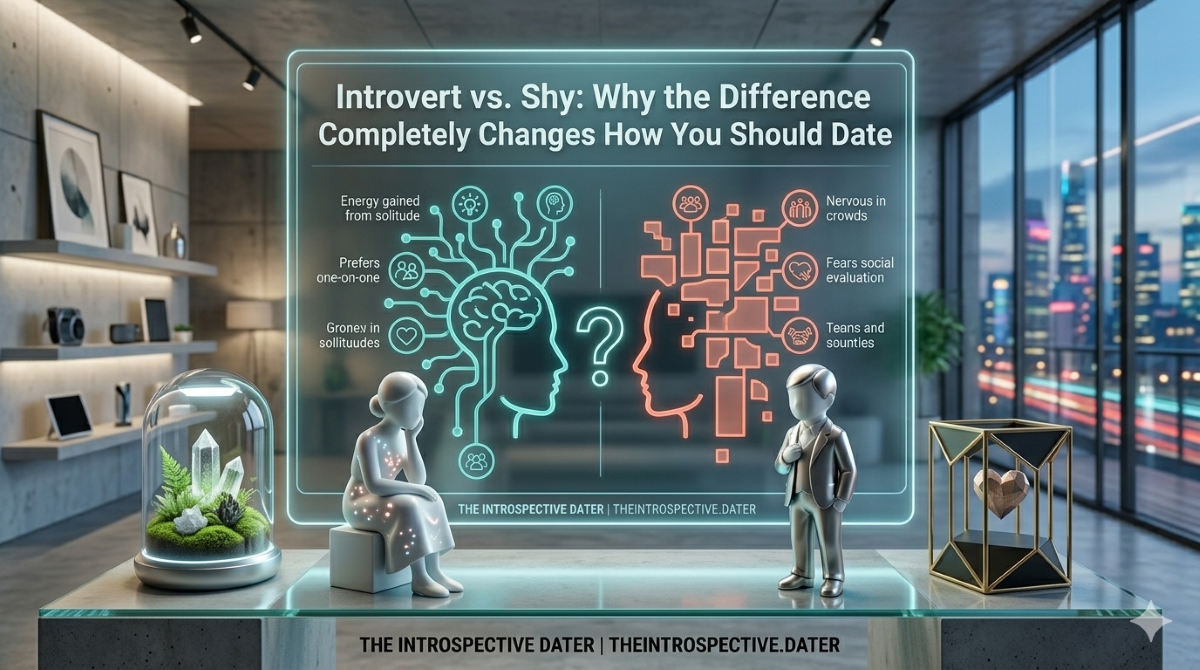
Ask someone on the street what an introvert is, and most will say some version of: "Someone who's quiet. Keeps to themselves. Doesn't really like people." That's shyness they're describing — not introversion. Introversion is about energy. It's a personality dimension, first formally defined by psychologist Carl Jung, describing people who are primarily energized by their inner world — thoughts, ideas, reflection — rather than external social stimulation. Introverts can be warm, funny, deeply social, and genuinely excellent in conversation. What distinguishes them is what happens afterward: they need solitude to recover.
Shyness, by contrast, is about fear. It's an anxiety response — specifically, the apprehension of negative social evaluation. A shy person wants to engage socially but feels held back by worry:
Will I say the wrong thing? Will they judge me? Will I embarrass myself?
The simplest way to see the difference: An introvert might decline a party because they'd rather stay home and read — and feel completely fine about that choice. A shy person might decline the same party while desperately wishing they could go, paralyzed by anxiety about what might go wrong if they did. One is a preference. The other is a fear. They require completely different responses.
Why This Gets Confused So Often
The conflation isn't accidental — there's a reason these two things blur together in popular understanding.
First, introverts and shy people can look identical from the outside. Both might be quieter in group settings, both might prefer smaller gatherings, both might take longer to warm up to new people. The internal experience is entirely different, but to an outside observer, the behavior can appear nearly the same.
Second, the overlap is real — you can absolutely be both introverted and shy. An introverted person can also carry social anxiety. An extrovert can also be shy (a combination that's genuinely confusing for the people who experience it — loud in some rooms, terrified in others). The traits aren't mutually exclusive, which makes clean separation harder.
Third, our culture has historically pathologized quietness. In a society that rewards boldness, networking, and "putting yourself out there," being reserved gets labeled a problem to fix rather than a trait to understand. That cultural pressure collapses the distinction — if both introversion and shyness look like social reserve, and social reserve is seen as a deficiency, both get lumped together as the same deficiency.
The result: introverts spend years trying to "overcome" something that isn't a limitation, while shy people receive advice that doesn't address the actual root of what they're experiencing.
Am I Introverted or Shy? The Questions That Actually Clarify It
If you're genuinely unsure which applies to you — or whether both do — these questions cut through the noise faster than any personality quiz.
After a great social event — one where you genuinely had fun — how do you feel? If you feel energized and want more, you're likely extroverted. If you feel pleasantly satisfied but ready to be alone, you're likely introverted. If you feel relieved it went okay and anxious about what people thought of you, shyness is likely in the picture.
When you turn down social plans, what's the internal experience? An introvert who declines feels at peace with the decision — maybe even quietly happy about a free evening. A shy person who declines often feels a complicated mix of relief and regret, wishing they were the kind of person who could just go.
In a small group with people you know well, are you a different person? Most introverts are — they open up significantly in comfortable, low-stakes settings. Shyness tends to ease with familiarity too, but the underlying anxiety about evaluation often remains even with people you know.
Do you avoid social situations because they drain you, or because you're afraid of what might happen? Depletion is introversion. Fear of outcome is shyness. Both can produce identical behavior — staying home — with entirely different emotional roots.
The honest answer for many people is: both, to different degrees. That's valid. The goal isn't a clean label — it's understanding which mechanism is actually driving your dating challenges.
How This Changes Everything About How You Should Date
This is where the distinction stops being theoretical and starts being practically important. Because the dating strategies that work for introverts are genuinely different from the strategies that work for shy people — and applying the wrong set to yourself is like taking the wrong medication.
If You're Primarily Introverted (Not Shy):
Your challenge isn't confidence — it's energy management and environment design. You're probably perfectly capable of charming someone when the context is right. The problem is that most dating app architectures and early-dating rituals are built to drain you before you get to show who you actually are.
Your dating strategy should focus on:
Controlling your environment. Choose first date settings that work for you — a coffee shop, a bookstore, a walk somewhere with a natural end point. Not a loud bar where you have to shout over music and perform social energy you don't have. The right setting lets you be actually present instead of spending half your mental resources managing overstimulation.
Going deeper faster. Small talk isn't your strength and isn't your obligation. It's okay to steer conversations toward something more substantive early. Ask a question that actually interests you. Mention something real. The person worth your time will follow you there — and the ones who don't weren't right for you anyway.
Being honest about how you recharge. You don't have to explain introversion on a first date. But as things develop, a partner who understands that "I need tonight alone" isn't rejection — it's maintenance — is a non-negotiable. This is a compatibility filter, not a confession.
Choosing platforms designed for depth. This matters more than most introverts realize. A platform that rewards thoughtful profiles, doesn't punish slower response times, and surfaces compatibility before chemistry gives you a structural advantage rather than a structural handicap.
If You're Primarily Shy (With or Without Introversion):
Your challenge is fear of evaluation, and no amount of environmental optimization solves that on its own. The strategies here are different — and more targeted at the root.
Separate the behavior from the belief. Shyness is largely driven by predictions: I'll say something wrong, they won't like me, I'll embarrass myself. These predictions feel like facts. They're usually not. The practical work is noticing the prediction, acting despite it in small doses, and letting the evidence accumulate that the feared outcome doesn't materialize as often as your brain insists it will.
Use low-stakes practice deliberately. Dating cold is hard when you're shy. The solution isn't to force yourself into high-pressure situations immediately — it's to expand your comfort zone gradually in environments where the stakes are genuinely low. A casual interest-based event. A group activity. Somewhere the goal isn't romantic and the pressure to perform is off.
Reframe what a "failed" interaction means. One of the most corrosive patterns for shy daters is treating any interaction that doesn't go perfectly as evidence of fundamental inadequacy. It isn't. It's data. Someone not texting back isn't a verdict on your worth — it's two people not being a fit, which happens to everyone, including the most socially confident people you know.
Consider whether working with a therapist makes sense. This isn't a dramatic suggestion — it's a practical one. If social anxiety is significantly limiting your life and relationships, Cognitive Behavioral Therapy (CBT) has strong research behind it as an effective approach. Dating strategies can only accomplish so much when anxiety is the underlying driver.
The One Thing Both Groups Share
Despite the differences, introverts and shy people often end up in the same place when it comes to modern dating: using tools and following advice that was designed for neither of them.
The default dating app experience — loud, fast, gamified, performance-driven — doesn't serve introverts, who are depleted by it. And it doesn't serve shy people, who are intimidated by it. The advice to "just put yourself out there" doesn't serve introverts, who are already out there plenty in the right conditions. And it doesn't serve shy people, because raw exposure without support doesn't reliably reduce fear.
Both groups deserve better than generic advice and extraction-focused platforms. At FindFlames, we built with the understanding that depth-first connection — the kind where you're seen for who you actually are before being evaluated on how quickly you perform — works better for the majority of real people than the swipe-and-sprint model that dominates the industry.
Whether your challenge is energy or anxiety, the solution looks the same: less noise, more signal. Fewer strangers, better matches. A pace that lets you show up as your actual self instead of the version of yourself you perform under pressure.
The Bottom Line
Introversion is an energy preference. Shyness is a fear response. They can coexist, they often get confused for each other, and they require meaningfully different approaches to dating.
If you've spent years trying to "be less introverted" — working on your boldness, forcing yourself to engage more, treating your need for solitude as a problem — you may have been solving the wrong equation entirely. Introversion isn't a limitation to overcome. It's a trait to understand and design around.
And if shyness is the actual driver — if it's fear, not preference, that's keeping you from the connection you want — then the path forward is less about dating strategy and more about gently, consistently expanding what feels possible.
Know which one you're dealing with. Then date accordingly.
FindFlames is built for the people mainstream dating apps forget — the ones who connect slowly, deeply, and on their own terms. Join us and find your kind of connection.