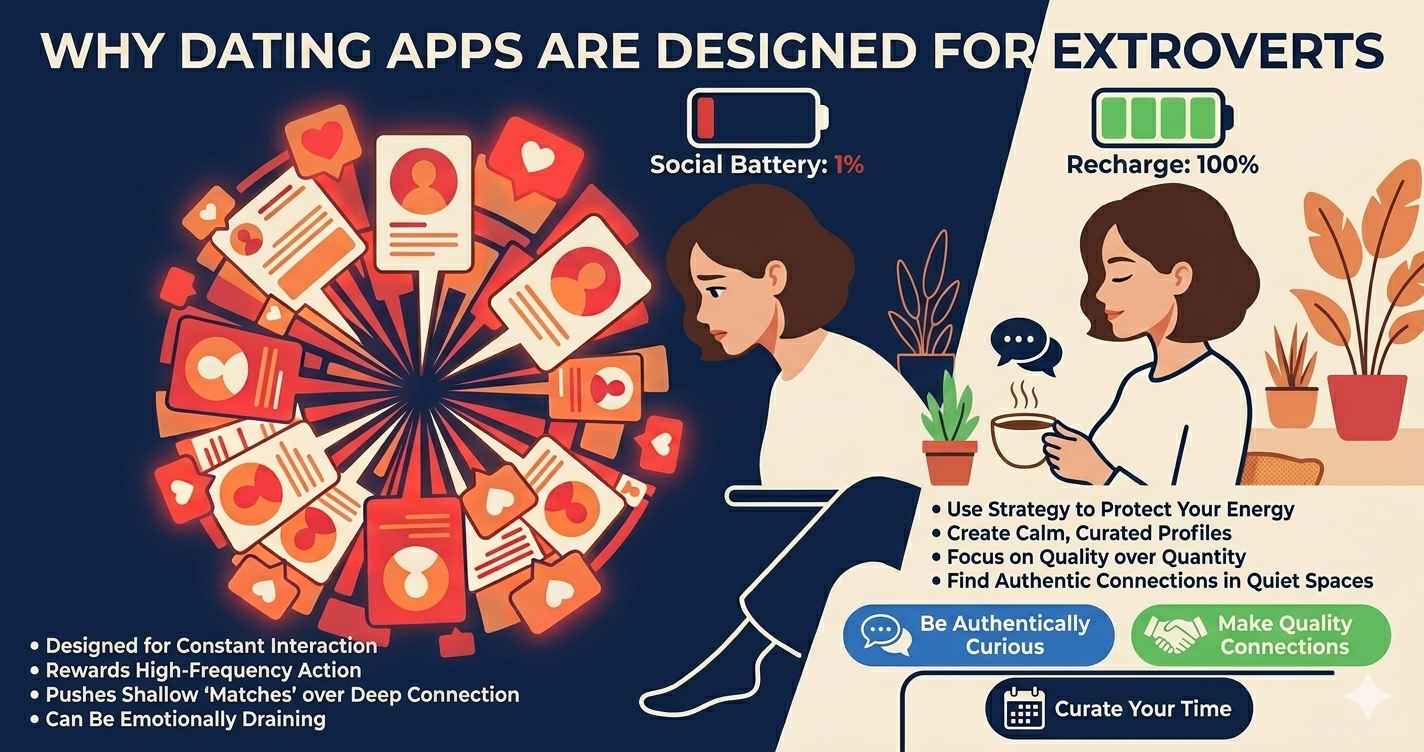
The Uncomfortable Truth: Dating Apps Reward Extrovert Behaviors
Here's a number worth sitting with: introverts make up an estimated 30–50% of the population. Yet the design philosophy behind nearly every mainstream dating app reads like it was written for the other half exclusively.
Swipe culture. Streak-based engagement. Expiring messages. Rapid-fire icebreaker prompts. "Boost your profile for 30 minutes" features. These mechanics don't just favor extroverts — they require extrovert energy to play well.
Modern dating apps are social performance stages. And if you're someone who finds deep, one-on-one conversation energizing but small talk draining — if you need a moment to think before you respond — you're already playing on hard mode.
What "Designed for Extroverts" Actually Means
This isn't just a vibe. It's baked into specific product decisions.
The swipe mechanic rewards snap judgments. The entire premise of swiping is: make a decision about a person in under three seconds, based on a photo and a headline. For extroverts — who research shows are more responsive to visual social stimulation and quicker to pursue novelty — this is a playground. For introverts, who are slower, more deliberate processors? It's a pressure cooker. Psychology research consistently shows introverts form more accurate first impressions when given more time and information. Swipe apps remove both.
The algorithm punishes slower engagement. Most apps algorithmically reward users who log in frequently, respond quickly, and keep conversations active. If you prefer to sit with a message and craft a thoughtful reply, the algorithm quietly buries you. Your profile gets shown to fewer people. Your matches go cold. You are actively penalized for communicating in the way that actually works for you.
The opener culture is an extrovert's game. For someone naturally great at small talk, firing off a charming opener is effortless. For introverts, starting a conversation with a stranger on demand — with no context, no warmth, no established chemistry — feels genuinely uncomfortable. Research on introversion and communication consistently finds that introverts prefer meaningful, context-rich conversations over surface-level exchanges. Dating apps force the exact opposite as a mandatory first step.
Profile prompts reward performance over depth. "List your most interesting fact." "Best travel story." "Your hot take." These prompts are designed to elicit bold, instantly charming responses — optimized for the person who leads with charisma. Introverts, who express depth through sustained interaction rather than quick performance, are left choosing between writing something dishonest or something invisible. Neither works.
The Research Is Clear: Introverts Are Deeply Capable of Meaningful Connection
Before going further, let's name the myth that dating apps quietly reinforce: that introverts are somehow less suited for romance.
The science says the opposite.
Research by Dr. Laurie Helgoe and studies from personality psychology journals consistently show that introverts build deeper emotional bonds over time, are measurably better listeners — a trait partners rank highest in relationship satisfaction — and tend toward greater self-awareness and emotional intelligence. They're also far more likely to be seeking committed, meaningful relationships over casual dating.
The problem has never been introvert suitability for love. The problem is that the funnel to get there — modern dating apps — was designed to filter people like you out before you ever get a real chance.
Why Introverts Specifically Struggle: The 5 Real Reasons
If online dating has felt harder for you than it seems to be for others, here's the honest breakdown.
1. Decision fatigue hits faster. Swiping through dozens of profiles triggers decision fatigue — a documented psychological phenomenon where decision quality deteriorates after extended choosing. Introverts, who process each profile more deeply, hit this wall significantly faster than extroverts. What feels like laziness is actually your brain running out of a finite resource.
2. Hollow small talk kills motivation. "Hey." "Hey :) how's your week?" This loop is most introverts' personal nightmare. Shallow conversation doesn't just bore introverts — it actively drains them. When every match starts the same way and the platform offers no path to something real, motivation collapses entirely.
3. Notifications are genuinely overstimulating. According to Hans Eysenck's foundational personality research, introverts have higher baseline nervous system arousal. The constant pings, badges, and nudges that keep extroverts perpetually engaged are, for introverts, a source of low-grade but cumulative stress. It's not a preference issue. It's neurological.
4. Photo-first platforms miss what makes you compelling. The qualities that make introverts magnetic — depth of thought, gradually revealed humor, genuine attentiveness — don't photograph. If your best qualities emerge through conversation rather than a curated grid, photo-first platforms structurally underrepresent you from the first moment.
5. The pressure to perform leads to inauthentic profiles. Introverts typically either overperform (writing a profile that sounds nothing like them, then feeling anxious about living up to it) or underperform (being so understated they become invisible). The platform creates this impossible choice. Neither version works, and both feel bad.
What You Can Actually Do About It
You don't have to abandon dating apps. You just have to use them differently — and choose platforms that don't actively work against you.
Write for depth, not broad appeal. Stop trying to sound universally likable. Introverts do best when their profiles act as conversation filters rather than billboards. Instead of "I love hiking and trying new restaurants" (everyone's profile, always), try something that reveals a real perspective:
"I've been rereading the same three authors for five years and I think that says something important about me. Ask me what."
This won't appeal to everyone. It's not supposed to. It's designed to attract the person who finds that genuinely interesting — and naturally repel the person who'll spend your first date talking only about themselves. Specificity is your actual superpower. Use it deliberately.
Create a sustainable engagement rhythm. Stop checking apps reactively throughout the day. Introverts thrive on intentionality. Give yourself two focused 20-minute sessions — one in the morning, one in the evening — and fully close the app in between. This eliminates the chronic low-level drain of passive scrolling and means the conversations you do have will be sharper, more thoughtful, and more you.
Move to a call faster than you think you should. Here's the counterintuitive truth: text-based conversation, which feels like the introvert's safe zone, is often where connections quietly die. The nuance that makes you compelling — your timing, your tone, the warmth behind your words — gets completely lost in text. Introverts actually perform better in focused one-on-one voice or video calls than in sprawling text threads. A 20-minute call can accomplish what three weeks of messaging never will. Suggest it early. The right person will appreciate the directness.
Match fewer people, more intentionally. The dominant logic of dating apps is volume: swipe widely, let the odds work. This logic wasn't built for introverts. Five genuine conversations are worth more than fifty hollow ones — in outcomes and in energy spent. Give yourself full permission to be selective. Read profiles before matching. Ask yourself: "Is there something here I actually want to talk about?" If the answer is no, keep moving without guilt.
Stop maintaining conversations out of politeness. Most introvert-dating-app exhaustion comes from sustaining a large number of shallow conversations that have no real trajectory. Give a conversation three or four exchanges to show genuine potential. If it's still "lol same, what did you do this weekend?" after four messages — let it go. You're not obligated to carry every match indefinitely.
The Bigger Picture: Why This Needs to Change at the Platform Level
Here's what strategies can only partially fix: most of this problem is architectural. Individual habits help, but what introverts actually need is a platform built from different design principles.
A 2024 Pew Research study found that nearly 80% of dating app users describe the experience as frustrating. Burnout, dehumanization, the commodification of attraction — these are consequences the industry created and has been slow to confront. The gamification model that drives engagement metrics also drives loneliness. That's not a bug. It's an accepted trade-off the industry made in exchange for retention numbers.
Introverts feel this more acutely because they process it more deeply. But the problem isn't theirs alone — it affects everyone willing to be honest about it.
What the industry actually needs to build looks like this: curated matches instead of infinite queues. Paced interaction without expiry pressure. Profiles built around values and depth rather than photo grids. Algorithms that reward authenticity, not just activity.
This is exactly what FindFlames was designed around. We built a platform on the belief that introverts aren't a niche edge case — they're half the people looking for love, systematically underserved by an industry that only knows how to build for the loudest energy in the room.
On FindFlames, you set the pace. Matches come with more context and intentionality. Conversations are built to go somewhere. And the platform isn't trying to maximize your time-on-app — it's trying to get you to the connection that makes you want to close the app for good.
A Note on the Introvert/Extrovert Spectrum
It's worth saying: introversion isn't a binary. Many people are ambiverts — energized by certain social situations and completely depleted by others. If you've ever left a great one-on-one dinner feeling full and a house party feeling hollow, you already understand this.
The point isn't to claim a label. It's to recognize which conditions let you show up as your most magnetic self — and deliberately create those conditions in your dating life.
The most successful introverts in modern dating aren't the ones who "learned to be more extroverted." They're the ones who stopped apologizing for how they connect, found the right context for it, and held out for someone who valued depth over performance.
Your Takeaway
If dating apps have left you feeling like you're doing something wrong, hear this clearly: you're not broken. The tool is.
You bring exactly what meaningful relationships are made of — depth, attentiveness, authenticity, and the genuine willingness to show up for someone. The issue has always been the environment, not the person.
Use the strategies above to tilt the playing field. And when you're ready for a platform that was actually built for your kind of connection — the slow burn, the real conversation, the this actually feels like something moment — FindFlames is here.
Because the best flames don't spark instantly. They build.
Ready to date on your own terms? Join FindFlames and discover what connection feels like when the platform works with you, not against you.